By Nicholas A. Freeman, PhD
Abstract
Rev. P. Barenaba was a native Hawaiian preacher, educator, legislator, and pastor whose story has been largely overlooked, despite his significant contributions to early Christianity in Hawaii. He was a prominent Christian leader in Hilo and Puna from the early 1830s through 1881, involved in all aspects of the church, including preaching the gospel in these areas before Rev. Titus Coan’s arrival, teaching Coan the Hawaiian language, and was a contemporary of Blind Bartimeus. Drawing upon historical sources including Hawaiian language newspapers, government records, and church records, this article reconstructs his life story, covering early gospel tours, educational ministry at Hilo, serving in the Hawaiian legislature, author of numerous newspaper articles and pastoring of the Kapalana Church, all of which illustrate the cooperative nature of service between native Hawaiians and the missionaries, including Titus Coan, in spreading the gospel throughout the Hawaiian Kingdom.
Keywords: Barenaba, Preacher, Pastor, Hawaiian schools, mission history, Hawaiian-language newspapers.
Rev. Barenaba (Barnabas, Baranapa, P.) was a native Hawaiian evangelist, educator and pastor who ministered in the schools and villages of Hilo, Waiakea and Puna beginning in the 1830s, through 1881. Before the Rev. Titus Coan ever toured his assigned district, Barenaba had already toured and preached the gospel throughout scores of villages in the region. As a contemporary of Blind Bartimeus, Chiefess Kapiolani, David Lyman, and Coan, he was one of the primary preachers and teachers of the district. His life story illustrates just how extensively native Hawaiian Christians served as an integral part of Christianity’s founding in Hawaii as well as helping to usher in the Great Hawaiian Revival of 1836-1842.
When the Coan’s first arrived in Hilo in 1835, Barenaba served as their Hawaiian language instructor. Coan wrote in his autobiography Life in Hawaii, “Ourselves, (he and his wife Sarah) pupils of a good man named Barnabas, who patiently drilled us daily in the language of his people.”1 Sarah Lyman recognized Barenaba’s value to the school, writing in 1835, “We think Barenaba praise-worthy, for what he has affected in this school.”2 Coan also wrote of an early lively exchange he witnessed between Barenaba (Barnabas) and a new local priest. He noted that Barenaba politely greeted the priest who then asked him, “What is the true church”, to which Barnenaba replied, “The true Church of God is composed of all true believers who love and obey the Lord Jesus, of every age and name and nation on earth and in heaven.”3
Barenaba was a prolific writer and educator, publishing an article in November 1835, addressing the correct translation of various Hawaiian words, using scripture verses from both the Old and New Testaments to illustrate his reasoning. This would seem to indicate that he was most likely an asset to the early missionaries involved in translating the Holy Bible.4 In another article from 1835, he implored the parents of the church body across Hawaii to care properly for their children, including providing a suitable education, using both reason and scripture to demonstrate his points.5
In January 1836 he published an article describing his preaching tour throughout Hilo and Puna, in which he shared the gospel repeatedly. This tour most likely contributed to laying the groundwork for the Great Hawaiian Revival,6 to come, especially in the Hilo and Puna district. He said of one moment on the trip at “Waipahoehoe, inland of Keaau, the people there gathered together upon seeing us; I asked them to assemble, and they gathered until the house was full. I preached the word of God to them and exhorted them to love the Lord Jesus Christ.”7 He preached the gospel in numerous villages including “Kamomoa, Pulama, Poupou, Kahaualea, Ki, and finally at Kupohua.”8 Overall, he preached at over seventeen locations.
In addition to his early preaching and teaching tour articles in various Hawaiian language newspapers, he authored at least ten local news articles, including an in-depth report of the tsunami at Hilo in 18379 and reports on rum related deaths.
Later that same year, in December 1837, he published an account of a second preaching and teaching tour of Puna, and nearby areas, in which school children were tested and the gospel was preached at each location including Kalapana, Keaʻau, Ahualaea, Namanu, and other villages with his assistant Kuhio, and later meeting up with Rev. David Lyman. Lyman had originally planned to travel with them but had been delayed by his son’s sickness.10 This no doubt helped build his relationship with the people at Kalapana, home to his future pastorate. Too, this among other evidence, shows that he traveled with the missionaries on their tours, and most likely had accompanied Coan on some of his tours.
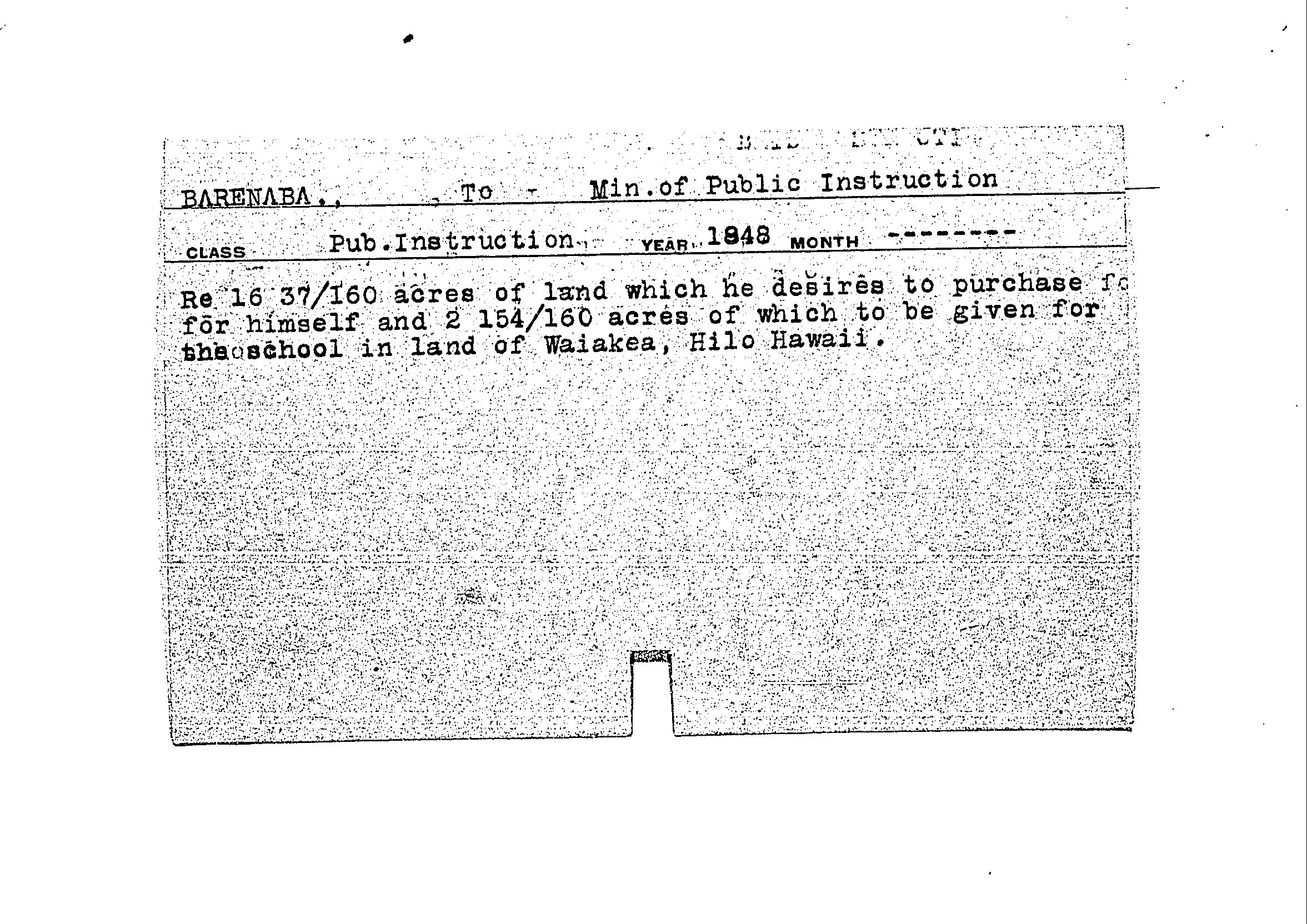
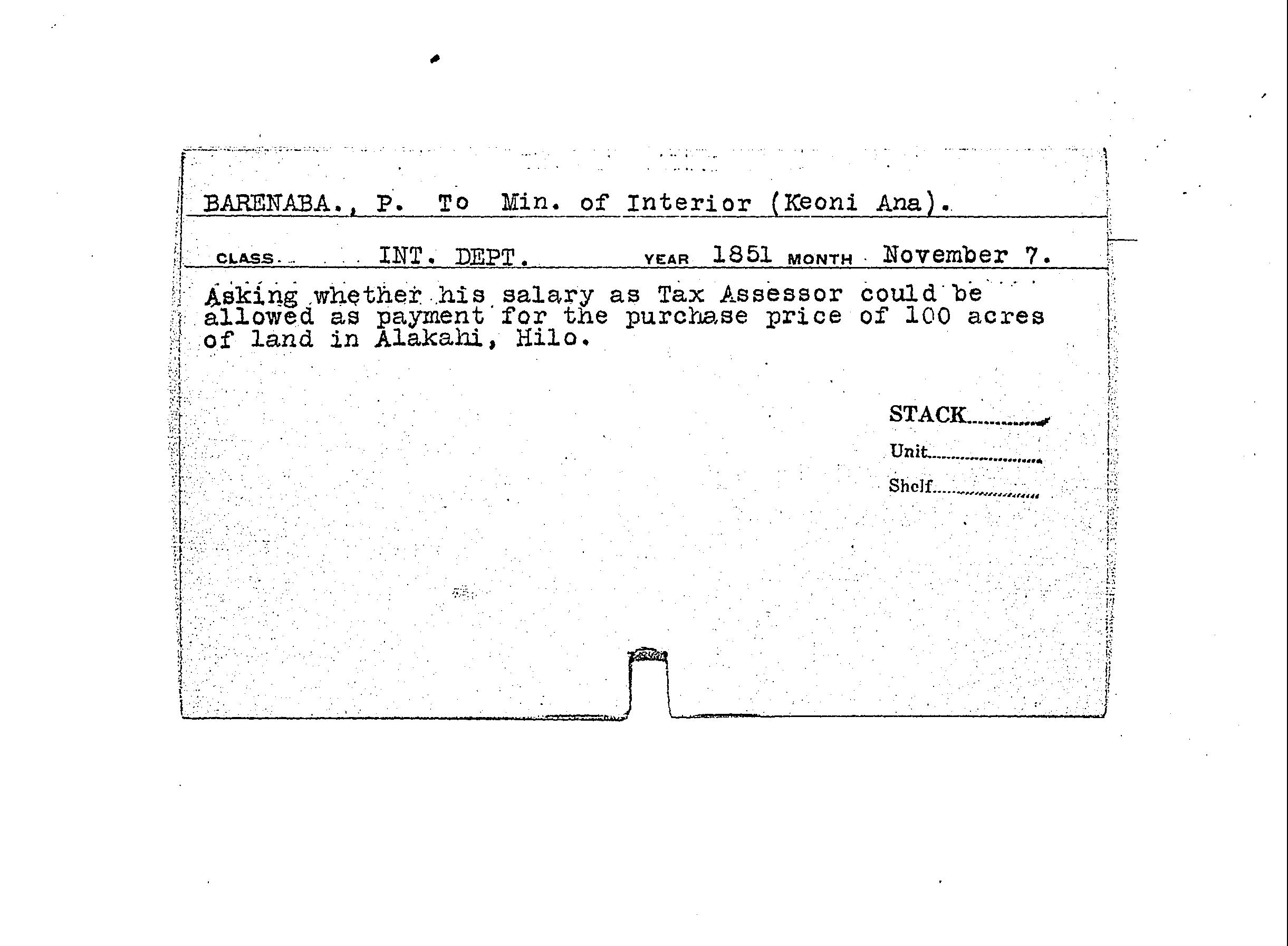
Later in 1844 he was one of two men elected as the school superintendents of the island of Hawaii.11 In 1848 he purchased 100 acres for a school in Waiakea,12 as well as a land parcel in Puna. He also served as a tax assessor in Puna,13 and later in Hilo in 1859-1860, appointed by the Minister of Finance,14 and was later elected as a member of the Hawaiian legislature.15
In April of 1869, in the later years of his life, he was ordained as the new pastor of the church at Kalapana, with Rev. Coan and others participating in the ceremony. For his part, Coan acknowledged their long-lasting relationship in sharing the gospel in Hilo and surrounding areas stating, “My dear brother, my companion on the cliffs of Hilo, you have persevered in the Lord’s work without growing weary until this very moment. You now take on this great and honorable office in your later years; therefore, serve your congregation with humility and without faltering, striving earnestly until the very end.”16 This illustrates the deep and lasting relationship between Coan and Barenaba.
Another illustration of their close ties is noted in a letter from Titus Coan’s son Titus Munson who mentioned Barenaba (Barnabas) in a letter to none other than Charles Darwin. In addressing infanticide in the Hawaiian Islands, Munson wrote, “So far as I have examined, the testimony is that infanticide made no distinction between the sexes. When one wished to be rid of a child the question of male & female had no weight in the decision. Such is the testimony of Paul, Barnabas, Job, & others of our old, intelligent, & reliable people. I would rather take the testimony of men like those I have named than all that has been published in books on the subject.”17
Not too long into his pastorate, Barenaba faced his first big trial when a large earthquake struck in 1871, in which newspapers reported caused extensive water damage to his property,18 however, only two lives were lost. The Pacific Commercial Advertiser reported that the “Coastline of the church, for a distance of about two miles, the place sank and formed a black sand beach.”19
As he continued to lead at Kalapana, the church began to grow. Official church records show that in just 1873 there were 19 professions of faith and a total of 269 members in regular standing.20 The members were also a giving church, donating $109.30 to foreign missions just in the year 1872.21 After serving successively for twelve years as the pastor of the Kalapana Church, Rev. P. Barenaba passed away in old age in August of 188122 at Hilo. His friend and fellow laborer Rev. Coan passed away the following year.
The life and ministry of Rev. Barenaba were distinguished by service, whether he was in the field as an evangelist, in the schoolhouse training new missionaries alongside children, superintending Hawaii schools, or pastoring his Puna flock. While largely absent from the major missionary narratives, the piecing together of his impact through varied historical sources illustrates just how involved Hawaiian Christians were in the establishment of the church throughout the Islands.
Sources
- Titus Coan, Life in Hawaii: An Autobiographic Sketch of Mission Life and Labors.
- Sarah Joiner Lyman, Sarah Joiner Lyman of Hawaii: Her Own Story, p. 73.
- Coan, Life in Hawaii, p. 98.
- Ke Kumu Hawaii, November 11, 1835, p. 178.
- Ke Kumu Hawaii, April 29, 1835, p. 103.
- Nicholas Freeman, The Great Hawaiian Revival.
- Ke Kumu Hawaii, April 13, 1836, p. 32.
- Ibid.
- Ke Kumu Hawaii, December 6, 1837, p. 54.
- Ke Kumu Hawaii, February 14, 1838.
- Ka Nonanona, August 6, 1844, p. 45.
- Digital Archives Hawaii land record.
- Digital Archives Hawaii tax record.
- Polynesian, August 6, 1859, p. 3.
- Digital Archives of Hawaiʻi catalog record.
- Ka Nupepa Kuokoa, September 4, 1869.
- T. M. Coan to Charles Darwin, June 22, 1874, Darwin Correspondence Project.
- Ka Nupepa Kuokoa, July 11, 1868, p. 2.
- The Pacific Commercial Advertiser, September 16, 1871, p. 3.
- The Friend, July 1873.
- The Friend, July 1872.
- Ka Nupepa Kuokoa, July 30, 1881, p. 2.